

Prologue:
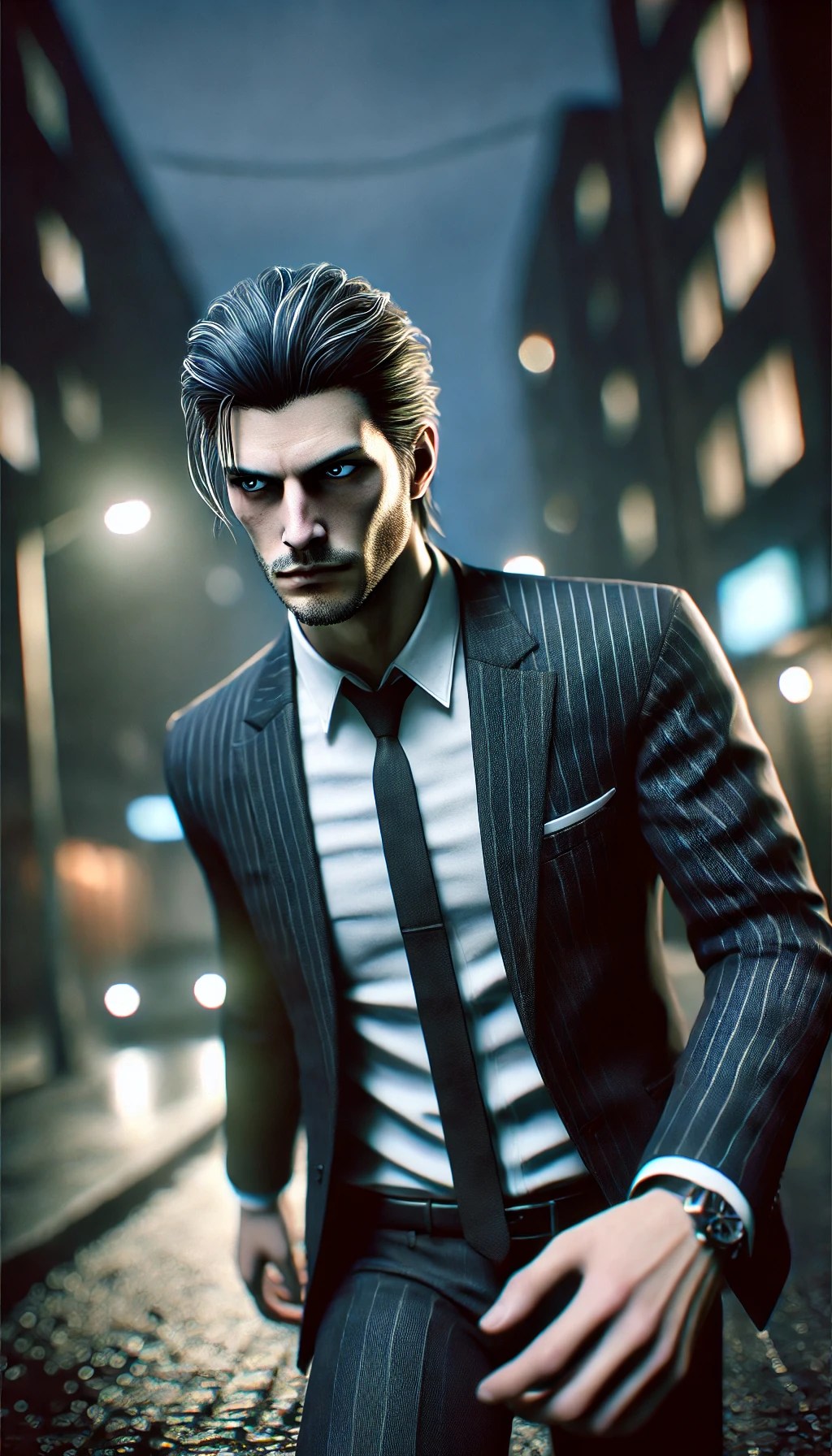
Eugene Lefkowitz is a tall, wiry fella, always lookin’ like he’s got one foot out the door. His sharp jawline’s got a permanent five o’clock shadow, and those piercing blue eyes? They don’t miss a trick. His slicked-back black hair’s startin’ to show a few streaks of gray, but that just adds to his charm—a weathered sorta look that makes dames curious and wise guys cautious. He’s always in a cheap suit, pressed so sharp it could cut you, and he’s got a knack for blendin’ into a crowd while still bein’ just noticeable enough to matter.
Then there’s Paddy Murphy, his partner in crime—or crime-solvin’, more like. Paddy’s a stout, broad-shouldered guy with a face that’s equal parts friendly and intimidatin’. He’s got a thick mop of red hair and a beard that’s trimmed just enough to stay respectable. His green eyes got a softness to ’em that don’t quite match his brickhouse build, and his fists? They look like they could knock a guy into next week. He rolls his sleeves up like he’s always ready for a rumble, suspenders holdin’ his bulk in check under his jacket.
Paddy might be the muscle to Eugene’s brains, but don’t let that fool ya—he’s got smarts of his own and a heart as big as his appetite for a stiff drink. Loyal to a fault, Paddy’s the kind who’d give you the shirt off his back but break your nose if you tried to take it without askin’. He’s a brawler through and through, but he’s also surprisingly good with kids and animals, and he’s got an ear for pickin’ up gossip in crowded joints.
Together, Eugene and Paddy are a perfect mix of cunning and brute force. They’ve been through hell and back, and after tanglin’ with the New York underworld, there ain’t much that scares ’em—least not enough to make ’em run.

Monroe’s Uptown House
The Dezer Building’s where me and Paddy hang our fedoras—Flatiron District, smack dab in the thick of it. The office ain’t much to look at, but it’s home base. Molly keeps the wheels greased and the place runnin’ smoother than a Duke Ellington riff. This morning, just as the coffee’s startin’ to percolate, the phone gives a jangle. Molly, with her usual sass, says, “It’s Nicky ‘Diamonds’ DeSalvo. He wants you at Monroe’s Uptown House pronto for a chinwag.”
Now, when Nicky calls, you don’t say no—not unless you got a death wish. So, we hoof it to Harlem, past the stoops and brownstones, where the streets hum with life. Kids play stickball, and sharp-dressed cats lean against lampposts, keepin’ tabs on the world.
When we get to Monroe’s, the joint’s dead quiet—just the smell of last night’s cigarettes hangin’ in the air. The place itself? A real gem. Monroe’s is where jazz rules the roost and the cats come to play till the sun peeks over the horizon. The setup’s simple: small stage, tables crammed tight, but the vibe? That’s pure gold.
We barely have time to take it all in before Nicky strides in, dressed sharper than a tack. His pinstripe suit’s so loud it could stop traffic, and the blood-red tie he’s sportin’ only makes it louder. Diamonds sparkle on his rings, his tie pin, even his cufflinks. The man’s a walking lighthouse.
“You Lefkowitz?” he says, his voice slicker than a greased axle.
“That’s me,” I reply, lighting a smoke. “This here’s Paddy Murphy.”
Nicky gives Paddy a nod. “Pleasure. Now, listen up. My star canary, Billie Holiday, she’s flown the coop. Name’s up in lights out front, and now she’s AWOL. Lena Horne, her roommate, don’t know squat. If she don’t show, I’ll look like a sap. You two gotta find her, and quick.”
I take a drag off my cigarette, blowin’ the smoke slow. “Any hot tips, or are we shootin’ in the dark?”
Nicky leans in, his voice dropping low. “She’s been tanglin’ with Rita ‘The Rose’ Rivera—jealous type, y’know? Then there’s her husband, Jimmy Monroe, and her fella, Joe Guy—the dealer. Both holed up at the Hotel Olga. That’s where you start.”
I glance at Paddy, who shoots me a look like he’s already calculatin’ the trouble. “Hotel Olga it is,” I say.
The Hotel Olga is buzzin’ like a hornet’s nest when we roll up. It sits on the corner of West 145th and Lenox, all mahogany trimmings and a swanky library, the kind of joint that screams class—a real gem in Harlem for folks who wouldn’t get past the door at most places downtown.
Murph and I mosey inside, giving the desk clerk a nod that says, “We’re not here to cause trouble—unless we have to.” After a quick inquiry, Lena Horne herself came down to meet us. She looked like she’d stepped out of a dream—eyes big and bright, smile sweet as honey, and a poise that could stop traffic dead.
“You must be the private dicks Nicky sent,” she said, her voice like a melody. “You’re here for Billie, ain’t ya? I’ve been worried sick.”
“That’s right, Miss Horne,” I said, pulling out my notebook. “When’s the last time you saw her?”
Ten days ago,” she said, wringing her hands. “She’s been gone before, but never this long. I called the cops after four days, but they brushed me off soon as they heard she’s a Black singer.”
I shot Murph a look. That kind of talk wasn’t a surprise, but it still made my blood boil.
“Did she seem jittery? Upset about anything?” Murph asks, his tone low and steady.
Lena hesitates, glances around like someone might be listening. “She gets that way when she’s off her fix. You know how it is.”
“Word is she’s got beef with Rita Rivera,” I said. “That true?”
Lena’s lips press tight. “Yeah, Billie and Rita got history, but don’t ask me to referee. If you’re lookin’ for Billie, though, you might wanna check with her husband, Jimmy Monroe, in room 312, or Joe Guy up in 415.”
We tip our hats, promising to keep her in the loop. Next stop: Jimmy Monroe.
“We’re tryin’ to track down Billie,” Murph says. “Mind if we step in?”
Jimmy shrugs. “Sure, but watch your step. Place ain’t exactly House Beautiful.”
He isn’t kidding. The joint reeks of stale booze and bad decisions. Clothes are piled on the furniture, and the ashtray is overflowing. Billie’s touch is nowhere to be found.
Heard you two had a spat before she disappeared,” I say, keeping my tone casual.
“Yeah, but it’s nothin’ new,” Jimmy replies, lighting a cigarette with shaky hands. “Billie’s got her ways, you know? We had words, she stormed out, and that’s the last I saw of her.”
“What about Joe Guy?” Murph pressed. Jimmy, blew out a plume of smoke. “That cat’s bad news. Billie says he’s her fella, but all he does is keep her hooked. I been tryin’ to get her off that junk.”
“Anything else you can tell us? Something that might help?”
Jimmy scratched his head, looking genuinely stumped. “Try Joe in 415. He knows more than I do.”
Joe Guy opened the door with a grin, a reefer dangling from his lips. The room was thick with smoke, the kind that makes the air heavy and the senses dull.
“You boys must be Eugene and Paddy,” he said, motioning to the worn-out couch. “Come on in.”
I stay standing, leaning against the wall. “We’re lookin’ for Billie. When’s the last time you saw her?”
“Ten days ago,” Joe says, shrugging. “She comes and goes like the wind, man. I wasn’t sweatin’ it at first, but now? I don’t know.”
Murph frowned, crossing his arms. “We heard there’s some heat from a fella named Victor. You know him?”
Joe shifted uncomfortably, taking a long drag off his reefer before answering. “Yeah, I know him. He’s a pusher with a short fuse. Billie and I owe him some scratch, and he ain’t exactly thrilled about it.”
“What kind of threats are we talkin’ about?” I ask, keeping my voice even.
“The kind you don’t ignore,” Joe said, exhaling smoke that curls in the dim light. “Victor’s got connections—mob types. You wanna find him, start askin’ around the Cotton Club.”
>Rita ‘The Rose’ Rivera is sittin’ pretty at the Hotel Theresa when we find her. The Theresa was Harlem’s crown jewel—sleek, upscale, and the kinda place where the elevator operator has a sharper suit than most of the patrons. Rita fit right in. She was all glitz and glamour, with a sharpness in her eyes that says she didn’t suffer fools gladly.
We knock, and when she opens the door, she gives us a once-over that could’ve curdled milk. “What’s this about?” she snaps, her tone sharper than her sequined dress.
“Billie Holiday,” I said, leaning casually against the doorframe. “Word is you two ain’t exactly swapping Christmas cards.”
Rita rolls her eyes and waves us in, muttering something under her breath about nosy gumshoes. The suite is plush—velvet drapes, expensive furniture, and a vanity crowded with more cosmetics than Macy’s. She perches on a chair, crosses her legs with a practiced elegance.
“Look,” she says, lighting a cigarette with a gold lighter, “I don’t keep tabs on Billie Holiday. Got my own life to live.”
“Sure,” Paddy said, his voice low and steady, “but you got beef with her. That true?”
Rita blows out a cloud of smoke and shrugs, but her sharp eyes give her away. “So, what if I do? That don’t mean I know where she is.”
I smile, keeping it friendly. “Fair enough. What about Victor? You know him?”
At the mention of Victor, her gaze flickers. She catches herself, but it’s too late. “Yeah, I know him. He’s bad news, but I don’t mess with that crowd. If you’re so curious, why don’t you try Slim Parker at the Braddock? He’s tighter with that scene.”
Her tone is flippant, but there’s a tremor beneath it. Rita knows more than she’s lettin’ on, but it isn’t worth pressing her—not yet. We tip our hats, leaving her to her smoky suite and uneasy thoughts.Top of Form
The Braddock wasn’t just a hotel—it was a social hot spot. Jazz musicians, writers, and performers congregate there, trading stories and tunes. Known for its colorful characters, you might run into a sharp-dressed hustler, a jazz cat with a horn, or a writer looking for inspiration.
On the front steps of the building a small group of musicians were jamming. I asked one of them if he knew Slim Parker.
Chapter 4: Slim’s Set-Up
We found Slim Parker noodlin’ on his saxophone at the Braddock Hotel, a low-lit spot where the jazz cats hung their hats. The Braddock isn’t fancy, but it has an air about it—the kind of place where a few bucks get you a stiff drink and the sweet sound of a tenor sax that drifts through the smoky air.
Slim’s lanky, cool as a cucumber, with fingers that glide over the keys like silk on a breeze. When he spots us, he doesn’t miss a beat, his sharp eyes scan us up and down as his tune trails off.
“You Slim Parker?” I asked, nodding toward his sax.
“Depends who’s askin’,” he says, setting the horn down on its worn leather case.
“Eugene Lefkowitz and Paddy Murphy,” I say. “We’re lookin’ for Billie Holiday. Your name came up.”
Slim leans back in his chair, crossing his arms. “Can’t imagine why. I ain’t seen Billie in a stretch.”
“Word is you’re tight with Victor,” Paddy said, his tone casual but his eyes locked on Slim.
Slim’s face darkened, but he played it cool. “Victor’s trouble, man. If you’re sniffin’ around him, you’d better tread light.”
“Where can we find him?” I asked, leaning in slightly.
He sighs, running a hand over his close-cropped hair. “Victor don’t like folks lookin’ for him. But if you’re serious, leave a message with the bartender at the Cotton Club. He’ll get it to Victor.” That was all Slim had to say. He picked up his sax and started playin’ again, his notes smooth and melancholy. We took the hint and left him to his music, the weight of his warning hangin’ in the air like the smoke from the bar downstairs.
Paddy lit a cigarette, the flare of the match casting shadows on his face. “So, Victor’s trouble, huh?”
“That’s like sayin’ Capone likes a drink or two,” I muttered, blowing out a plume of smoke.
“Yeah, but trouble’s exactly what we’re in the business of findin’, ain’t we?” replied Paddy, pulling his coat tighter against the chill.
The street was alive with the hum of the city. Couples strolled past, and a car backfired in the distance. We started walking, keeping our eyes peeled and our ears open. The Cotton Club wasn’t far, but it felt like the kind of place you didn’t just waltz into without a plan. Victor’s name carried weight, and Slim’s warning wasn’t just for show.
“You think Slim’s blowin’ smoke about Victor?” Paddy asked, flicking ash into the gutter.
“Nah,” I said. “Guy’s got nothin’ to gain by leadin’ us on. If anything, he’s tryin’ to keep us from stickin’ our noses where they don’t belong.”
“Yeah, but our noses always end up where they don’t belong,” Paddy quipped with a wry grin.
Shady Deals at the Cotton Club
“Alright, Murph,” I said, throwing my coat over my shoulder, “let’s beat feet to the Cotton Club. Somethin’ tells me the guy slingin’ drinks there might be our ticket.”
The Cotton Club was lit up like a Christmas tree, and the band inside was swingin’ so hard it could make a corpse tap its feet. The joint was packed to the gills—high rollers and low-lifes rubbin’ elbows, all lost in the spell of a hot trumpet and cool piano. It was the kind of place where the right word could get you a fistful of answers, but the wrong one could land you face-first in an alley.
Murph and I bellied up to the bar, settlin’ on a pair of stools like we belonged there. The barkeep was an old-timer, lean as a reed, with a shock of white hair that caught the dim light just right. His eyes, sharp as razors, sized us up without missin’ a beat.
“Two scotches, neat,” I said, watching him close.
When he brought the drinks, I slapped a twenty on the bar and kept my mitt on it.
“Hold up there, pops,” I said with a little smirk to grease the wheels. You the guy who funnels messages to Victor?”
The old guy froze, his hand clutchin’ a rag like it was a lifeline. His eyes narrowed into slits.
“Don’t know what you’re jawin’ about, mister. You payin’ for them drinks, or do I call the gorillas?”
Murph let out a soft chuckle, leanin’ back like he had all the time in the world. Me? I leaned in, my voice low enough to make him sweat.
“Take it easy, gramps. Word is, you’re the fella to see. We’re workin’ for Nicky ‘Diamonds’ DeSalvo, lookin’ for Billie Holiday. If I tell Nicky you’re stiffin’ us, well, let’s just say things might get real unfriendly for you.”
The old man wilted, lettin’ out a long sigh. He wiped his brow with that rag, glancin’ around like the walls had ears.
“Alright, alright. I don’t need no trouble, especially not from DeSalvo. What d’you need?”
“We’re supposed to meet Victor,” I said, keepin’ it straight. “Don’t know his mug. When he shows, just give us a nod. You do that, we’re square.”
The barkeep shoved the rag into his apron, lookin’ like he’d aged ten years.
“Fine. But you two mugs better not make me regret this.”
“You stay outta the way, and you’ll never hear our names again,” I said, slidin’ the twenty his way.
It didn’t take long before the old guy gave us the signal—a quick jerk of the chin toward a skinny joe sittin’ in a booth near the stage. The fella was slick as an oil spill, wearin’ a pinstripe suit that didn’t quite fit, with a nervous energy that could make a rabbit look cool.
Murph slid off his stool, takin’ the seat next to Victor while I planted myself across from him. The table was sticky with years of spilled booze, but that was the least of my worries.
“Victor,” I said, my tone even but firm. “We’re buyin’, but not the kinda snow you’re thinkin’. Spill what you know about Billie, or the bulls’ll be bangin’ down your door faster than you can say ‘Sing Sing.’”
Victor gave me a greasy grin, but his eyes stayed cold.
“You’re barkin’ up the wrong tree, Shamus. Big mistake—real big. You keep sniffin’ around, and you’ll find yourself in a world of hurt.”
“Oh yeah?” I said, leanin’ in. “And who’s gonna bring the pain? You?”
His grin stretched wider, but it was all teeth.
“Lucky Luciano. And when I tell him what you two are up to, you’ll be swimmin’ with the fishes. Capisce?”
Murph, calm as ever, just shrugged.
“Maybe so,” he said, his voice low. “But we already dealt the cards, pal. Nothin’ left to do but play the hand.”
Victor leans back, his fingers tappin’ out a nervous rhythm on the table.
“You’re digging’ your own graves, boys. Hope you brought shovels. Now, can I blow this joint, or are we gonna keep pretendin’ you’re in charge?”
I waved him off, my patience wearin’ thin.
“Scram, before I change my mind.”
Victor didn’t need tellin’ twice. He was up and out the door like the devil was nippin’ at his heels.
As the door swung shut behind him, Murph glanced my way.
“Well, that went smooth as sandpaper. What now?”
I drained the last of my drink, feelin’ the burn on the way down.
“Now? We find out how deep this rabbit hole goes. And if Lucky’s really callin’ the shots, we’d better keep our heads on a swivel.”
Bottom of Form
“You two keep your noses clean, and we’ll keep things simple. I got a job for you. Somebody is skimming from me and I wan’t to find out who it is. Do that and I’ll have my boys nose around for information about Billie Holiday. My drivers will see you back.”
The ride back is a carbon copy of the trip in—smooth as silk but quiet enough to hear our own hearts beat. Back at the office, me and Murph park ourselves in the beat-up chairs and start weighin’ our odds.
“Well, Murph,” I say, leanin’ back like I’m not half as worried as I feel, “what’s your take? Feels like we’re wedged between a rock and the hard stuff.”
Murph scratches his chin, his mug set like stone. “Eugene, here’s how I see it—we play ball, stay sharp, and keep it as straight as we can. Lucky’s a sharp cat, but if he asks us to step over the line, we gotta be ready to think fast and pivot. Ain’t no shame in watchin’ our own backs.”
I grin, feelin’ just a flicker of hope in all the muck. “Murph, you’re a diamond in a coal mine, you know that? Here’s to keepin’ our noses clean and our heads above water.”
I grab a bottle, pour us each a drink, and raise my glass. “To makin’ it out alive.”
The next morning, me and Murph pile into my Tin Lizzy. She ain’t flashy, but she gets the job done. In this town, black cars like her blend into the scenery like shadows. Paddy keeps sayin’ I oughta spring for somethin’ classier, but I tell him the Lizzy’s perfect for work like this—plain, reliable, and easy to disappear in.
Our first stop is a speakeasy tucked in a back alley downtown, the kind of joint where whispers carry more weight than the booze. Lucky’s suspicions are clear: somebody is skimming dough from his rackets. It doesn’t take long for us to pick up a scent. Joe Adonis is at a corner table, slick as oil on glass, talkin’ low with Charles ‘The Ox’ Workman.
The Ox is Schultz’s old muscle—a gorilla with fists like sledgehammers and a face only a mother could love. Seein’ him here sets my radar buzzin’. Paddy nudges me, his eyes locked on the table where Adonis slides a sealed envelope across to the Ox. Whatever is inside, it isn’t Christmas cards.
“Think they’re up to somethin’?” Paddy whispers, his tone dry.
“No question,” I mutter, watchin’ the Ox pocket the envelope before they shake hands and split.
We tail Adonis for the next few nights, piecin’ together his moves. He’s slick, but not slick enough to lose us. From secret meetings to unusual stops, the breadcrumbs lead to one conclusion: Adonis is double-dealin’. Skimming off Lucky’s rackets and passin’ the dough to the Ox and his crew, Adonis isn’t just crooked—he’s makin’ waves that could sink ships.
We find more dirt, too. Letters—unsigned but unmistakably incriminating—addressed to the DA’s office. Turns out Adonis is spillin’ the beans to the feds, feedin’ dirt in exchange for immunity. Worse yet, he’s tippin’ them off about Lucky’s operations.
“We’ve gotta play this one smart,” I say as we park outside one of Adonis’s haunts. “If we go to Lucky without solid proof, it’s our necks on the line.”
“Then we get proof,” Paddy replies, his tone firm. “Adonis wants to play the rat? Let’s see how he likes bein’ caught in the trap.”
The trap comes together like clockwork. Paddy, with his Irish charm, poses as a go-between for a rival crew, arrangin’ a fake meet with Adonis. We pick a quiet warehouse down by the docks, the kind of place where shadows do most of the talkin’. I hide nearby, camera in hand, ready to snap evidence.
Adonis spills just enough to incriminate himself—mentions skims, payoffs, and the Ox’s involvement. I get the shots and the notes, every piece we need to make the case airtight. When Adonis shakes hands with Paddy and walks out, he doesn’t have a clue he’s just tied his own noose.
Presentin’ the proof to Lucky is a tightrope act over a pit of knives. Lucky doesn’t have much love for bad news, and the messenger doesn’t always walk away clean. But we lay it all out anyway, piece by piece, like we’re dealin’ a hand of cards.
Lucky’s expression doesn’t change as he flips through the photos and notes. When he finishes, he leans back, takin’ a long drag off his cigarette. “Well, boys,” he said, his tone like steel wrapped in velvet, “looks like you earned your twenty-five bucks a day, plus expenses.”
Murph and I exhale, but the tension doesn’t leave the room. Lucky’s cold stare lingers on us like a hangover. “Keep this up,” he added, “and maybe there’s more work for you. Screw it up? Let’s just say you won’t get a second chance.”
The fallout comes quick. Adonis must’ve figured out he’s been made, ’cause he skips town that night. Or at least, he tries to. Lucky’s boys catch up with him at the train station. What happens next? Well, let’s just say Adonis ain’t gonna be talkin’ to the feds no more.
Paddy and I sit in the office the next day, goin’ over the details. “Well, Murph,” I say, pourin’ us both a drink, “we played the hand we were dealt, and we’re still breathin’. I’d call that a win.”
“For now,” Paddy replies, clinkin’ his glass against mine. “But Lucky ain’t the type to let things rest. We’re in this deep, Eugene. The question is—how do we get out?”
I don’t have an answer, so I just take a sip of my drink, lettin’ the silence speak for itself.
Closing In
A few days later, we’re back at the office, piecin’ together everything we have. The shadowy figures at the docks, the phony union hall—it all points to someone tryin’ to worm their way into Lucky’s operations. But the real kicker is the connections to the DA’s office. This isn’t just a turf war; it’s a full-blown setup.
“Eugene, you think Lucky’s got rats in his own crew?” Paddy asks, leanin’ back in his chair.
“Could be,” I say, tappin’ ash from my cigarette. “Or it’s somebody outside lookin’ to squeeze him. Either way, we’re runnin’ outta time. Lucky ain’t the type to wait for answers.”
The phone rings, cuttin’ through the tension. Molly’s voice comes through sharp and clear. “It’s one of Lucky’s boys. Says you’re needed at the Palermo tonight.”
The Palermo is more than just a spaghetti joint. It’s the kind of place where deals are made, alliances forged, and betrayals punished—all over plates of branzino and red wine. If Lucky’s callin’ us there, it means things were about to heat up.
We arrive at the Palermo just as the place is startin’ to fill up. The maître d’ gives us a once-over before noddin’ us toward the back room, where Lucky and his inner circle are already gathered. The table was set with fresh flowers, crystal glasses, and enough charm to mask the tension in the air.
Lucky gestured for us to sit, his expression unreadable. “You boys been busy,” he said, lightin’ a cigarette. “I hear you’ve got somethin’ for me.”
“We do,” I say, layin’ the photos and notes on the table. “The two fellas at the docks—they’re connected to the DA. Been usin’ a fake union hall as cover to poke around your operations.”
Lucky’s eyes flick over the evidence, his jaw tightenin’. “Names?”
“Didn’t get ’em yet,” I admitted. “But we got a lead on where they’re hidin’ their files.”
Lucky nods, his tone cold and deliberate. “Then you finish the job. I want those files, and I want to know who’s pullin’ the strings.”
The “lead” was a dingy office above a pawnshop in Hell’s Kitchen. We wait until the small hours, when the streets are quiet, and slip inside through a fire escape. The office is a mess—papers scattered, a typewriter half-covered in dust, and a safe that looks like it hasn’t been cracked in years.
“Think you can handle it?” Paddy asks, glancin’ at the safe.
I grinned, pullin’ out my lockpicks. “This ain’t my first rodeo, Murph.”
It took a few minutes, but the safe finally gave in with a satisfying click. Inside, we find what we we’re lookin’ for: a stack of files thick enough to make a DA’s career. Names, dates, shipments—all tied to Lucky’s operations. But there was somethin’ else, too—a ledger with payments made to someone on the inside.
Paddy flips through the pages, his brow furrowin’. “Eugene, look at this. These ain’t just small-time bribes. Whoever’s takin’ this dough’s been feedin’ the DA everything.”
“Somebody close,” I mutter, my gut tightenin’. “Lucky’s got a mole.”
We bring the files back to Lucky the next morning. He doesn’t say much as he flips through ’em, but the look on his face tells us all we need to know. When he reaches the ledger, his jaw clenches.
“You boys did good,” he says finally, his voice low. “But this ain’t over. I need to find out who’s behind this, and I need it yesterday.”
“Any suspects?” Paddy asks, but Lucky just shakes his head.
“That’s for me to worry about,” he says. “You two focus on followin’ the trail. And keep your noses clean.”
As we leave the Waldorf, the weight of the job hangs heavy between us. “Eugene,” Paddy said, his voice low, “this mole business? It’s got all the makings of a bloodbath.”
“Yeah,” I reply, lightin’ a smoke. “And we’re right in the middle of it.”
The silence that follows isn’t just quiet—it’s foreboding, like the calm before a storm.Top of Form
Lucky’s orders are simple: follow the trail, and don’t stop until you hit the source. But there’s nothin’ simple about the mess we’re wadin’ into. A mole in Lucky’s crew isn’t just dangerous—it’s explosive. If we don’t handle it right, we’ll end up just as buried as the rat we’re chasin’.
Shell companies, each one shadier than the last. It’s a classic move—bury the money deep enough, and it’ll take a miracle to dig it up. Good thing me and Murph are feelin’ like miracle workers.
“This one’s tied to a speakeasy in the Bronx,” I say, tappin’ the ledger with my finger. “Small place, off the radar. Might be worth a visit.”
“Or a fight,” Paddy mutters, already checkin’ the chamber of his revolver. “Either way, we’re goin’ in prepared.”
The speakeasy is tucked behind a boarded-up storefront, its only sign a red bulb flickerin’ above the door. Inside, the joint’s packed, the air thick with smoke and the low hum of conversation. We don’t bother playin’ it subtle—there isn’t time for games.
We find the owner, a wiry guy with slicked-back hair and shifty eyes, countin’ cash behind the bar. I lean in close, my voice low but firm. “Word is you’ve been funnelin’ payments through here. We ain’t leavin’ till you tell us where they’re goin’.”
The guy freezes, his hands hoverin’ over the cash. “I don’t know nothin’,” he stammers, his voice tremblin’.
“Wrong answer,” Paddy growls, grabbin’ the guy by the collar and yankin’ him halfway over the bar. “Try again.”
“All right, all right!” the guy sputters, his eyes wide with fear. “It’s a drop! Money comes through here, then goes to a warehouse down by the river. That’s all I know, I swear!”
Paddy lets him go, and the guy slumped back, his hands shakin’ as he reached for a cigarette. “You’d better be tellin’ the truth,” I said, flickin’ a quarter onto the bar. “Keep the change.”
The warehouse is dark and quiet, the kind of place that gives you the creeps even in broad daylight. We wait till nightfall before makin’ our move, slippin’ inside through a side door that creaks louder than we liked.
The place is full of crates, most of ’em stamped with phony labels to hide their contents. But it isn’t the booze we’re after—it’s he ledger we know has to be here.
“Over here,” Paddy whispers, noddin’ toward an office tucked in the corner. We ease the door open, our eyes landin’ on a desk piled with papers. And there it is—a second ledger, this one even more incriminatin’ than the first.
“This ties the payments straight to the DA,” I say, flippin’ through the pages. “And look at this—names, addresses. Somebody’s been keepin’ detailed notes.”
“Somebody who’s about to have a real bad day,” Paddy says, tucking the ledger into his coat.
We barely make it out before the trap springs. A pair of headlights cut through the dark, and a car screeches to a stop outside the warehouse. Voices shout, boots hit the ground as men pile out, guns drawn.
“Looks like we overstayed our welcome,” Paddy mutters, duckin’ behind a stack of crates.
“Yeah, no kiddin’,” I reply, my hand on my piece. “You got a plan?”
“Shoot first, run later.”
It isn’t the most elegant plan, but it’s all we have. We open fire, the warehouse eruptin’ into chaos as bullets ricochet off metal and wood. It isn’t long before the goons retreat to their car and speed off, leavin’ us breathin’ heavy and countin’ our blessings.
We bring the second ledger straight to Lucky. He doesn’t say much as he flips through it, but the look in his eyes is colder than a winter storm. “You boys done good,” he says finally. “This’ll clean house. But there’s one more thing you need to do.”
“What’s that?” I ask, though I already know the answer.
“Find the mole,” Lucky says, his voice low and deadly, “and make sure they don’t see tomorrow.”
As we leave the Waldorf, Paddy lets out a low whistle. “Eugene, this ain’t just a storm. It’s a hurricane.”
“Yeah,” I reply, lightin’ a smoke. “And we’re standin’ right in the eye of it.”
The Mole Revealed
Finding the mole isn’t gonna be easy. Lucky’s outfit is tight, and anyone on the inside smart enough to play him wasn’t gonna slip up easy. We have the ledger, the evidence, and the names, but no face to pin it all on yet. And with Lucky breathin’ down our necks, time is somethin’ we don’t have in spades.
We start with the names in the ledger. Most are small-timers, guys who’d do what they’re told without askin’ questions. But one name keeps poppin’ up—Vincent “Vinnie the Dime” Carducci, a middleman who handles payouts and isn’t known for keepin’ clean hands.
“Think it’s Vinnie?” Paddy asks as we pore over the notes in the office.
“If it ain’t him, he’s close enough to smell the rat,” I reply. “Time to have a chat.”
We find Vinnie at a pool hall in Hell’s Kitchen, loungin’ in the corner with a cigar hangin’ from his lips and a stack of chips in front of him. The place reeks of smoke, stale booze, and bad decisions. Vinnie spots us as we walk in, his smirk faltering for just a second before he plasters it back on.
“Lefkowitz, Murphy,” he drawled, leanin’ back in his chair. “To what do I owe the pleasure?”
“Just a friendly visit,” I say, takin’ the seat across from him while Paddy looms behind. “We’ve been diggin’ into some business, and your name keeps comin’ up. Care to explain?”
“Business, huh?” Vinnie says, blowin’ a cloud of smoke. “You boys actin’ on Lucky’s orders? Or is this freelance work?”
“Lucky’s,” Paddy says, his tone low and steady. “And he ain’t gonna like it if you’re holdin’ out on us.”
Vinnie chuckles, but there is a nervous edge to it. “Now, now, let’s not jump to conclusions. I’m just a middleman, y’know? Movin’ money from one place to another. Nothin’ shady.”
“Sure,” I say, leanin’ in close. “Except for the part where those payments end up in the DA’s pocket. You wanna try that again?”
Vinnie’s smirk disappears. He glances around, lowerin’ his voice. “All right, all right. Maybe I handled some cash that found its way into the wrong hands. But I ain’t the one pullin’ the strings.”
“Then who is?” Paddy growls, grabbin’ Vinnie by the collar.
Vinnie gulps, his cigar fallin’ to the table. “It’s… it’s Charlie De Luca! He’s the one feedin’ info to the DA. I swear, I’m just the delivery boy!”
Charlie De Luca is one of Lucky’s top lieutenants. If Vinnie is tellin’ the truth, this isn’t just a mole—it’s a betrayal that cut right to the heart of Lucky’s empire. We don’t have time to doubt him. If Charlie is the rat, he has to be dealt with before he can do any more damage.
We track Charlie to a private poker game in a swanky joint downtown. The room is all velvet curtains and crystal chandeliers, the kind of place where the booze is expensive and the stakes are higher. Charlie’s at the center of it all, his grin wide as he rakes in another pot.
“You fellas lost?” he asks when we walk in, his tone light but his eyes wary.
“Not at all,” I say, takin’ a step closer. “We’re here to talk about your side gig.”
Charlie’s grin falters. “I don’t know what you’re talkin’ about.”
“Sure you do,” Paddy says, his hand restin’ on his piece. “The DA, the payoffs, the ledgers. It all points back to you.”
The room goes dead quiet. Charlie’s eyes dart to the other players, then back to us. “You boys don’t wanna do this,” he said, his tone icy. “You don’t know who you’re messin’ with.”
“Neither do you,” I said, pullin’ out the ledger and tossin’ it on the table. “Lucky knows, Charlie. And he don’t take kindly to betrayal.”
Charlie’s face turns pale, but he doesn’t fold. Instead, his hand shoots to his coat, pullin’ a revolver. Paddy was faster. The shot echoes through the room, and Charlie slumps over, his cards scatterin’ across the table.
We bring the news to Lucky that night. He doesn’t say much, just nods and lights a cigarette. “Good work,” he says, his voice calm but cold. “You boys earned your keep tonight.”
As we leave, the weight of it all settles heavy on our shoulders. “Eugene,” Paddy says, his voice low, “how much longer do you think we can keep this up?”
“I don’t know,” I reply, lightin’ a smoke. “But one thing’s for sure—Lucky ain’t gonna let us walk away clean.”
The silence that follows is thick with unspoken fears, the kind that don’t go away with a drink or a good night’s sleep.
Tying Up Loose Ends
The night after Charlie De Luca’s fall, the city seems quieter than usual. Maybe it’s just my imagination, but it feels like the streets are holdin’ their breath. Me and Paddy know we’ve done our job, but somethin’ about the whole affair doesn’t sit right.
Back at the office, we sift through what’s left of the case. The ledgers, the names, the payouts—it all paints a picture of betrayal and greed. But every piece of evidence we’ve handed over to Lucky also paints us deeper into his picture. We aren’t just on his payroll now; we’re part of his machine.
“So, Eugene,” Paddy says, breakin’ the silence. “We took out the mole. What’s Lucky’s next move?”
I lean back in my chair, lightin’ a smoke. “If I had to guess? He’ll clean house. Anyone who so much as sneezed near Charlie’s operation is gonna get the axe.”
“And us?” Paddy asked, his tone careful.
“We’re too useful to cut loose,” I said, lettin’ out a slow stream of smoke. “For now.”
The next morning, Lucky calls us to the Waldorf. Same sleek jalopy, same stone-faced gorillas. But this time, the air is heavier, like the city itself knew somethin’ was about to break.
Lucky’s already waitin’ when we arrive, loungin’ behind his desk with a cigarette burnin’ low in his hand. He doesn’t waste time on small talk.
“Charlie’s boys are still out there,” he says, his voice cold. “They’ll scatter if I don’t act fast. You two are gonna make sure they don’t regroup.”
“Consider it done,” I say, keepin’ my tone steady. “Where do we start?”
Lucky slides a piece of paper across the desk. “These are the addresses. Start with Jimmy Gallucci. He’s been runnin’ numbers outta a bar in Harlem. Make it quick, and make it quiet.”
The bar’s a dive, the kind of place where even the flies seem desperate to get out. Jimmy Gallucci’s at the back, his beefy frame hunched over a pint. He doesn’t even look up when we walk in.
“Jimmy,” I say, takin’ the seat across from him. “We need to talk.”
He freezes, his hand hoverin’ over his glass. “I don’t know nothin’,” he mumbles, his voice tight.
“Sure you don’t,” Paddy says, takin’ up a position by the door. “But we’re not here for nothin’. You’re tight with Charlie. That makes you a liability.”
Jimmy’s face turns pale. “I didn’t know he was double-crossin’ Lucky,” he says quickly. “I swear, I’m loyal!”
“Loyal don’t cut it,” I say, my tone sharp. “Lucky wants this cleaned up. You got one chance to tell us who else’s in on it.”
Jimmy stammers, his eyes dartin’ between me and Paddy. “It was Frankie and Pete! They’re in deep, but I—I’m just followin’ orders.”
“Where are they now?” Paddy asks.
“Frankie’s layin’ low at his sister’s place in the Bronx,” Jimmy says. “Pete? I don’t know. Last I heard, he was skippin’ town.”
By the time we finish with Frankie and confirm Pete’s escape, the sun’s comin’ up over the skyline. We report back to Lucky that afternoon, layin’ out what we’ve learned.
“Frankie’s handled,” I say. “Pete’s runnin’, but he won’t get far.”
Lucky nods, his expression unreadable. “Good. I’ll have my boys keep an eye out for Pete. As for you two… ” He leans forward, his dark eyes boring into mine. “You’ve done well. But don’t get comfortable. There’s always more work to be done.”
That night, Paddy and I sit in the office, the silence between us thicker than the fog rollin’ in off the Hudson. “Eugene,” Paddy says finally, his voice low. “How much longer do you think we can keep this up?”
I didn’t answer right away, just stared at the papers on the desk—the evidence of a life we’d built brick by brick, job by job. “As long as we have to, Murph,” I say, lightin’ a cigarette. “Until we figure a way out.”
“And if there ain’t one?” Paddy asks.
I look at him, the weight of the answer hangin’ in the air like smoke. “Then we keep movin’, one job at a time.”
Shadows of Harlem
Harlem has a way of changin’ after dark. The lively chatter and vibrant jazz give way to whispers in alleyways and shadows that stretch longer than they have any right to. For me and Paddy, the city at night is both a shield and a trap—cover for the work we do, but also a reminder that we’re always one wrong move away from disappearin’.
The jobs for Lucky have slowed to a trickle since Charlie’s crew has been dismantled. Most of the names in the ledger had either gone underground or been taken care of, and the few stragglers still kickin’ weren’t makin’ any waves. But it’s the quiet that unnerves me the most. Quiet never lasts.
It’s close to midnight when the phone rings in the office. Molly’s gone home hours ago, so it’s just me and Paddy left to hear the jarring buzz. I pick it up, half expectin’ it to be Lucky with another late-night job.
Instead, the voice on the other end was low and shaky, “You Eugene Lefkowitz?”
“Who’s askin’?” I say, already reachin’ for the notepad on my desk.
“Name’s Eddie,” the voice said. “I got somethin’ you’re gonna wanna hear. Meet me at the corner of 135th and Lenox in an hour. Come alone.”
The line went dead before I could ask anythin’ else.
“Think it’s a setup?” Paddy asks as we make our way uptown. He’s carryin’, and so am I. In our line of work, paranoia isn’t just smart—it’s survival.
“Could be,” I admit. “But if this Eddie’s legit, he might have somethin’ worth hearin’.”
The corner of 135th and Lenox is quiet when we get there. The streetlights cast long shadows over the cracked pavement, and the only sound is the faint hum of a saxophone floatin’ out of a nearby window.
Eddie shows up a few minutes later. He’s a wiry kid, no older than twenty, with a nervous energy that makes him look like he’s ready to bolt at any moment.
“You Lefkowitz?” he asks, glancin’ over his shoulder.
“That’s me,” I said. “What’s this about?”
Eddie shoves his hands deep into his coat pockets, his voice low. “I work down at the docks. Heard some fellas talkin’—sayin’ there’s a new crew movin’ in on Lucky’s territory. Big shipment comin’ in tomorrow night. They’re plannin’ to hijack it.”
“Who’s behind it?” Paddy asks, steppin’ closer.
Eddie shook his head. “Don’t know their names. Just know they ain’t local. Out-of-town boys, maybe from Philly. Real heavy hitters.”
I exchange a look with Paddy. This isn’t just small-time trouble—this’s somethin’ that could turn Harlem into a war zone.
“Why’re you tellin’ us?” I asked.
Eddie hesitates, glancin’ around like he expects someone to jump outta the shadows. “’Cause if Lucky finds out I knew and didn’t say nothin’, I’m a dead man. Figure you two can handle it before it gets outta hand.”
The docks are dark and quiet when we arrive the next night, but the tension’s thick enough to cut with a knife. We find a good spot to hunker down, watchin’ the shadows for any signs of movement.
It dosen’t take long. A group of men creep outta the darkness, their faces hidden by flat caps pulled low. They move quick, workin’ together to crack open a crate marked “Textiles.” Inside is somethin’ a lot more valuable—Lucky’s booze.
“Looks like Eddie wasn’t lyin’,” Paddy muttered, his hand on his revolver.
“Yeah,” I say, my own piece ready. “But we gotta know who they’re workin’ for before we make our move.”
We wait, lettin’ them load a couple of crates into a waiting truck before steppin’ outta the shadows. “That’s far enough, boys,” I call, my voice steady. “Why don’t we have a little chat?”
The leader turns, his hand goin’ for his gun, but Paddy was faster. His shot rings out, hittin’ the man square in the shoulder and sendin’ him to the ground.
The rest of the crew freezes, their hands shootin’ up. “All right,” I say, keepin’ my piece trained on them. “Who sent you?”
“Does the name, Lucky Luciano mean anything to you?”
The wounded man grits his teeth, his face pale. “You don’t know who you’re messin’ with,” he spits. “This ain’t Lucky’s town no more.”
I step closer, my voice low. “That so? Then you won’t mind tellin’ me who’s takin’ over.”
The man didn’t answer, but the fear in his eyes told me enough. Whoever was behind this, they aren’t just playin’ around.
We leave the rest of the crew tied up for Lucky’s boys to deal with and head back to the office. Paddy’s quiet, his expression dark.
“You think this is the start of somethin’ bigger?” he asks as we pour ourselves a drink.
“Feels like it,” I say, takin’ a long pull from my glass. “Whoever’s behind this ain’t just after the booze. They’re sendin’ a message.”
“And what message is that?”
“That Lucky’s reign ain’t as solid as he thinks,” I say, settin’ my glass down. “And we’re the ones stuck in the middle.”
The Brewing Storm
Rain lashes against the windows of the Deezer Building, the wind howling like a banshee down the narrow alleys of Harlem. The city’s restless, as if it knows something big is about to break. I sit by the window, a cigarette dangling from my lips, staring at the blurred city lights. Across the room, Murphy’s pacing, his brow furrowed like a man with too many thoughts and not enough answers.
“We’re runnin’ outta rope, Eugene,” Murphy mutters, his hands shoved deep into his pockets. “Capone’s breathing down our necks, the cops are sniffin’ around, and the songbird’s trail is colder than a corpse in the lake. Hold on, that sounds like a book title. I remember, ‘Lady in the Lake’ by Raymond Chandler.”
I take a long drag and exhale a thin stream of smoke. “She’s out there, Murph. She didn’t just vanish. Somebody knows something, and we’re gonna find out who.”
Murphy stops pacing and pours himself a stiff drink from the chipped decanter on the desk. “Yeah, but at what cost? We keep pokin’ the hornet’s nest, we’re liable to get stung.”
Before I can answer, there’s a knock at the door—three sharp raps, followed by a pause, then two more. It’s the signal. I stub out my smoke and nod at Murphy, who slides his hand inside his jacket, fingers brushing the cold steel of his revolver.
“Come in,” I call, my voice calm but firm.
The door creaks open, and Sargeant O’Malley steps in, dripping wet and looking like he’s been dragged through hell backwards. His trench coat’s slick with rain, and his hat hangs limp in his hand.
“You boys better sit down,” O’Malley says, his voice low and gravelly. “I got news, and it ain’t the kind you wanna hear.”
I motion for him to take a seat, but O’Malley shakes his head. “No time for pleasantries. Word on the street is someone’s puttin’ out feelers—big money to shut you two up for good. And I mean big money.”
Murphy swears under his breath, his grip tightening on the glass. “That Capone’s handiwork?”
O’Malley shakes his head. “No. It’s somethin’ bigger. Someone’s pullin’ strings from the shadows, and they ain’t shy about splashin’ cash to make problems disappear. You boys are neck-deep in somethin’ you don’t understand.” My eyes narrow. “We’ve been swimmin’ in the deep end for a long time, O’Malley. Who’s behind it?”
The Irishman hesitates, then pulls a crumpled piece of paper from his coat pocket and tosses it onto the desk. I unfold it, my jaw tightening as he reads the name scrawled in shaky handwriting.
“Devereaux.”
Murphy frowns. “Who the hell is
“Devereaux?”
O’Malley leans in, his face pale. “You ever hear of the Black Orchid Syndicate?”
Murphy’s drink freezes halfway to his lips. “Yeah. They’re a ghost story—a whisper in the wind. Nobody knows who they are, but they’re supposed to be bad news.”
“They ain’t no ghost story,” O’Malley says. “They’re real, and Devereaux’s their mouthpiece. If they’ve taken an interest in you, it means two things: you’re close to somethin’ they want, and you’re expendable.”
I lean back in my chair, my mind racing. “What’s their angle? Why go after us?”
O’Malley shrugs. “Beats me. But if you wanna stay alive long enough to find out, you’d better start lookin’ over your shoulder.”
Murphy drains his glass and slams it down on the desk. “Great. Just great. As if Capone wasn’t enough, now we’ve got some shadowy syndicate gunnin’ for us.”
I fold the paper and slip it into his pocket. “Thanks for the tip, O’Malley. You’d better lay low. If they’re watchin’ us, they’re watchin’ you too.”
The Irishman nods, pulling his hat back on. “You boys be careful. Storm’s brewin’, and it’s gonna be a nasty one.”
He slips out into the night, leaving me and Murphy alone with the sound of rain and the weight of his warning. For a moment, neither of us speaks. Then Murphy breaks the silence.
“What’s the play, Eugene? Do we keep diggin’ or cut our losses?”
I light another cigarette, my face feels like stone. “We dig. Whoever Devereaux is, they’ve got answers. And if the Black Orchid Syndicate wants us gone, that means we’re on the right track.”
Murphy shakes his head, a wry smile tugging at his lips. “You’re gonna get us killed one of these days.”
“Maybe,” I say , exhaling smoke. “But not tonight.”
Outside, the storm rages on, a dark promise of the chaos to come.
The next day the sky is gray as dishwater, like the mood in our office. Molly picks up the horn as it jangles on her desk.
“Eugene, it’s for you. The fella won’t say who he is. Want me to put him through?”
I tip my hat to her efficiency and grab the receiver. “Lefkowitz here. Who’s talkin’?”
The voice on the other end is colder than a cop’s handshake. “Who I am don’t matter. Word is you’re sniffin’ for Billie Holiday. She’s holed up in apartment 501 at the Dunbar Apartments, West 150th Street. Quit diggin’ before you dig your own graves.”
Click. The line goes dead.
I set the receiver down and turned to Murphy. “Paddy, pack it up. We’re back in the game. I got the drop on Billie’s location. Dunbar Apartments. Half an hour if the traffic’s kind.”
Murphy grins and grabs his coat. “Let’s roll. Feels good to be back in action.”
The Dunbar: Trouble in a U-Shape
The Dunbar Apartments looms ahead, classy yet foreboding, its U-shaped courtyard like a big ol’ bear trap waiting to spring. We ride the elevator to the fifth floor, our hands hovering near our pieces. Apartment 501 is just down the hall.
Murphy and I flank the door, guns drawn. I gave a sharp rap.
“Who’s there?” a gravelly voice barks.
“Telegram for this apartment,” I say, smooth as silk.
“Slide it under the door.”
“Nah, pal, I need a John Hancock, or I don’t get paid.”
“Fine, hold your horses,” the voice grows.
The door creaks open, and a gorilla of a man stands there, packing heat. He barely clocks us before he lets a shot rip. We fire back, and he hits the deck like a sack of spuds.
More shots come from inside. Murphy and I answer with iron, and when the smoke clears, three are down for good. The fourth, winged and whining, is cuffed and left in the hallway. “What gives? I ain’t done nothin’!” the guy squawks.
“Save it for Nicky ‘Diamonds,’ pal. He loves a good sob story.”
Billie’s Rescue
Inside, we find Billie Holiday tied to a chair, shaken but looking sharp for someone in a jam.
“Well, Miss Holiday,” I say, holstering my piece, “Nicky’s been losin’ sleep over you. You got any bags?”
She shook her head, her voice steady. “I came with nothin’. Two mugs bust into my place and draged me here. They were yappin’ about someone named Devereaux. That’s all I know.”
“Don’t sweat it, Miss Holiday. Nicky’ll fill in the blanks. We’re just the delivery boys.”
A quick call to Nicky, and cleanup is on its way: three stiff customers and one who wouldn’t be makin’ happy hour. We bundle Billie into the car and head for Monroe’s Uptown.
Monroe’s Uptown: A Sweet Payoff
Nicky ‘Diamonds’ is all smiles when he sees Billie step into his office. “You boys pulled a rabbit outta a hat. Drinks are on me. Now, what’s the damage?”
“Twenty-five a day plus expenses,” I say.
“That’s chump change for what you just did. I’ll sweeten the pot. Check with the bartender—he’s holdin’ your dough.”
We stroll up to the bar, where the bartender hands us five hundred clams. “You two must be somethin’ special. Nicky’s tighter than a safe, and he just cracked it for you. Drinks?”
“Two scotch, neat,” Murphy says, settling in.
But the bartender comes back with a buzzkill. “Hate to spoil the mood, but Victor’s got his boys out huntin’ you. Watch your backs.”
The 10th Precinct: A Friendly Chinwag
After draining our glasses, we hightail it to the 10th Precinct for a word with Sergeant O’Malley. His feet are up on the desk, a cigar parked in his teeth.
“Well, if it ain’t Mutt and Jeff,” he says, smirking. “Still alive, I see. What’s the dirt?”
“We’re on the Black Orchid Syndicate’s hit list,” I say, “What can you tell us?”
O’Malley leans forward, his face serious. “The Orchid? Sketchy outfit, tied to Chicago. Word is Capone’s got his fingers in it.”
Murphy’s eyes narrow. “That means it’s time to have a word with Lucky Luciano. He might be able to call off the dogs.”
I nod, already feeling the weight of the next move. “Looks like we’re not done yet.”
Murphy sighs. “Eugene, I can’t wait to get back to cases where the worst thing we face is a cranky landlord.”
“Me neither, pal. But until then, we play the hand we’re dealt.
Paddy’s eyes narrow as he leans against the wall, the glow of my cigarette casting shadows across his mug. “So, how we pull this off without endin’ up floatin’ in the East River, Eugene? You got a real angle, or is this just hot air?”
I smirk, flickin’ ash to the floor. “Listen, Paddy. We ain’t amateurs. We’ve done this song and dance before. First, we get ourselves a truck, somethin’ beat-up but still hummin’, so it don’t stand out. A Model A Ford oughta do the trick. Then we need the uniforms—work shirts, caps, maybe grease ‘em up a bit. We gotta look the part, y’know, proper salt-of-the-earth types.”
Paddy rubs his chin. “Fine, so we look like truckers. But how do we figure out where to drop the net?”
“That’s where Dutch’s old crew comes in,” I say, puffin’ out a cloud of smoke. “We get in touch with Frankie ‘the Weasel’. He’s still sniffin’ around Dutch’s old haunts in the Bronx. Frankie’s the kind of guy who knows who’s movin’ what, where, and when. He owes us one from that Yonkers job, so he’ll spill for the right price.”
Paddy chuckles. “Frankie, huh? That crumb’d sell out his own mother for a sawbuck. Alright, say he points us in the right direction. Then what?”
“Then we find the warehouse,” I reply. “The one where these mugs are loadin’ up Al’s booze and swappin’ it for their own junk. We watch, take notes. Who’s comin’, who’s goin’. We make like ghosts, see? Nobody even knows we’re there. Once we got the lay of the land, we swoop in.”
“How’s that work?” Paddy asks, raisin’ an eyebrow.
I grin. “Easy. We wait ‘til one of their trucks breaks down or one of their drivers takes a powder. Sooner or later, it’ll happen—these operations ain’t perfect. That’s when we step in. Offer to cover the load, claim we’re fill-ins from the union. With the right papers—and Frankie can get us those—we’re golden. They’ll be so desperate to keep things movin’, they won’t think twice.”
Paddy snorts. “And if they do? What then, smart guy?”
I take another drag, blowin’ smoke rings. “Then we play dumb. We’re just a couple of joes tryin’ to make an honest buck. Keep it cool, and they’ll wave us through. We deliver the load like pros, get the goods to where they’re supposed to go, and keep our eyes peeled for anything hinky. Who’s callin’ the shots, who’s cuttin’ deals. We gather the intel and report back to Snorky.”
Paddy scratches the back of his neck, still not convinced. “And what if they catch us pokin’ around?”
“That’s why we gotta make nice with the right people,” I say, my voice low and firm. “The boys Frankie hooks us up with? They gotta be in on the grift. If we grease the right palms, we’ll have just enough protection to skate by. And if it all goes sideways, we got an exit plan.”
Paddy raises an eyebrow. “Exit plan, huh?”
“Yeah, the same way we came in,” I reply. “The truck’s got a false bottom. If we gotta scram, we stash the evidence, dump the booze, and hightail it outta there. Nobody’s the wiser.”
He lets out a sigh, nodding slowly. “Alright, Eugene. But you’d better be right about this. One wrong step, and we ain’t ghosts—we’re corpses.”
I grin, clappin’ him on the shoulder. “Relax, Paddy. We’ve danced with the devil before, and we’re still standin’. This is just another gig, and we’ll come out smellin’ like roses—or at least whiskey.”
Paddy,” I say, “tell me about that pal of yours with the junkyard. Sounds like we oughta pay him a visit.”
“Mike? Yeah, he runs Hicksville Auto Wreckers over on West Barclay. Fella’s got a knack for turnin’ junk heaps into somethin’ you’d wanna show off at the track.”
When we got to the yard, Mike was there, leanin’ on a rusty hood, smilin’ like a cat in a fish market. “Fellas,” he says, “lemme show you around. This here’s where the magic happens.”
He went on about how he turns clunkers into champs, braggin’ about stickin’ a Bugatti Brescia engine into a midget racer. “Thing’s got side pipes runnin’ like snakes down its length,” he said. “She’s got the roar of a lion and handles like a dream.”
Mike chuckles, tellin’ us about Bill Schindler, a driver who wrecked one of his creations in Mineola. “Poor guy crammed his ride into the fence,” Mike says. “Lost his leg after that, but he wasn’t the type to throw in the towel. Slapped on a prosthesis and went on to win the EMRA indoor midget championship. Tough as nails, that one.”
Impressive as the story was, we weren’t there to gab about race cars. “Mike,” I said, “we’re lookin’ for a cargo truck somethin’ that runs smooth but looks rough enough to pass under the radar. Got anything?”
Mike grins. “You want a whiskey wagon, huh? I ain’t askin’ why, but I’ve done my fair share of those. False bottom, no ID, plates clean as a whistle—you got it. Come back in a couple days, and she’ll be ready.”
The Stakeout
After settin’ up with Mike, we hit Harlem for some second-hand uniforms. Found some greasy caps, roughed-up shirts, and pants that’d seen better days. Frankie the Weasel hooked us up with fake union badges—just in case anyone got nosy.
Couple days later, Mike called. “Truck’s ready,” he says. We picked it up, parked across from the warehouse, and started watchin’. Trucks rolled in and out, workers switched shifts, and Paddy pulls out snacks like it was a picnic.
“Whatcha got, Murph?” I asked.
“Fig Newtons, Cracker Jack, a Babe Ruth bar, and a trio of sodas—Dr. Pepper, Frosty Root Beer, and Grape Nehi. You?”
“I had two Hershey bars, but I scarfed ’em. Think we can hit the drugstore?”
Paddy snorted. “Eugene, stakeout 101—ya leave, ya miss somethin’. Tough it out.”
We stick it out, waitin’ till the coast is clear. When the time is right, we drive to the dock, pick up a shipment of rotgut moonshine, and hit the road to Victor’s place. But before we get there, we pull over, ditch the truck, and take any notes or papers that can blow back on us. By the time anyone figures it out, we’re ghosts, leavin’ just enough crumbs for Al to tighten the screws on his rivals.
Visiting Snorky
You don’t just walk into Al Capone’s office. We slid in the back door of the Waldorf and got stopped by a mountain of a man who looked like he could bend steel bars. “What’s your business?” he growls.
“Snorky’s expectin’ us,” I say.
He makes a call, then leads us up to the third floor. The knock on Al’s door is a rhythm—a secret code, no doubt. Inside, Al says puffin’ on a cigar, lookin’ like the king of the world.
“Lefkowitz and Murphy,” he says, smilin’. “I remember you two. Sit. Let’s talk.”
“Good to see you, Snorky,” I say.
“Snorky,” he repeats, pleased. “Classy, right? Means stylish, dapper. Suits me, yeah?”
“Absolutely,” I say.
“So, Eugene,” he says, leanin’ back. “What’s the word?”
I lay it all out: the surveillance, the truck, the booze. By the end, Al’s noddin’ like a proud father.
“Good work, boys,” he says. “I like how you operate. I’ll be sendin’ more work your way.”
“Thanks, Snorky,” I say. “We’ll be ready.”
A Call from Billie
Back at the office, Molly hands us a message. “Billie Holiday called. Wants to talk. Shall I put her through?”
“Go ahead,” I say, pickin’ up the receiver.
“Hello, Miss Holiday. How can we help?”
“Call me Billie,” she says with a soft laugh. “I wanted to invite you to dinner tomorrow night at Monroe’s Uptown House. Drinks and a meal on me.”
We get to Monroe’s just as Billie’s singin’ “Summertime.” Her voice can make the coldest heart melt. After her set, she joins us at our table, gracious as ever.
“This one’s on me, boys,” she says. “Order what you like.”
We feasted like kings—steak, lamb chops, duchess potatoes, asparagus with lemon. The drinks kept comin’, and dessert? Baked Alaska, showin’ up with all the fanfare of a Broadway debut.
When the band comes back, Benny Goodman and Gene Krupa tear it up with ‘Sing, Sing, Sing.’ Next, Billie takes the mic and sings ‘Riffin’ the Scotch,’ dedicatin’ it to us.
By the end of the night, we’re floatin’ on a cloud of good booze and better company. Billie kisses us on the cheek before headin’ back to the stage, leavin’ us grinnin’ like fools.
The Next Morning
We stagger into the office, heads poundin’. I pour Murph a scotch. ‘Hair of the dog,’ pal.”
Molly storms in, scoldin’ us like a schoolmarm. “Shape up or ship out!” she snaps before slammin’ the door.
A moment later, she pokes her head back in. “Snorky’s on the line. Should I put him through?”
“Go ahead,” I say.
“Boys,” Snorky says cheerily. “I got a job for ya. Dutch’s old crew’s makin’ noise. See what they want, and cool it down. Capiche?”
“Got it, Snorky,” I say. “We’re on it.”
“C’mon, Murph,” I say, grabbin’ my hat. “Let’s ride.”Top of Form
How It Plays Out
“First stop is Lena’s place at the Olga,” I said, buttoning up my coat. “We’ve been needing to check in with her anyway. She might have a bead on what’s got Schultz’s boys all hot under the collar.”
Murphy groaned, rubbing his temples. “You sure we can’t stop for some aspirin first? My head’s poundin’ like Krupa’s drums last night.”
“No time for pity parties, Murph,” I said, pulling him to his feet. “Snorky’s waitin’, and you know how he gets when people drag their heels.”
At the Olga Hotel
Lena greet us in the lobby, her usual sharp wit on full display. “You boys look like you tangled with a bottle and lost.”
“Funny, Lena,” I say, forcing a grin. “We need to talk. Got any news on Dutch’s old crew? Seems they’re stirrin’ up trouble, and Snorky wants us to cool it down.”
She glances around before motioning us to follow her upstairs. Once inside her room, she pours herself a cup of coffee and leans against the counter. “Word is, some of Schultz’s boys are mad about being left out in the cold after he got iced. They’re grumbling about Capone muscling in where they think they still have claim.”
“Any names?” Murph asks, pulling out his notebook.
“Just one that keeps coming up: Frankie Malone. He’s been barking the loudest, stirring up the others. If you’re looking to make nice, he’s the one you’ll wanna talk to.”
“That would be Frankie ‘the Weasel’ would it not? Where can we find him?” I ask.
“He’s been hanging around a speakeasy in Hell’s Kitchen—The Black Cat Club. But watch yourselves; he’s got a short fuse and a lot of friends who don’t take kindly to outsiders.”
“Appreciate it, Lena,” I said, tipping my hat. “You’re a peach.”
“Just don’t get yourselves killed,” she shot back. “I’m runnin’ out of people I actually like in this city.”
The Black Cat Club
The Black Cat Club is the kind of joint that look rosugh even from the outside. The neon sign buzzes faintly, and the smell of cheap booze and desperation seep into the air. Murph and I exchange a look before stepping inside.
The place is packed with hard-faced men nursing drinks and watching their backs. It doesn’t take long to spot Frankie Malone at a corner table, holding court with a couple of bruisers. We approached cautiously, not wanting to spook him.
“Frankie Malone?” I ask, sliding into the seat across from him.
“Who’s askin’?” he replies, his eyes narrowing.
“Eugene Lefkowitz and Paddy Murphy. We’re here on behalf of Al Capone.”
That got his attention. He leans back, smirking. “Snorky’s sendin’ his lapdogs now? What’s he want?”
“To understand what’s got you riled up,” I said evenly. “He’d rather talk than turn this into a bloodbath.”
Frankie laughs, a dry, humorless sound. “Talk? That’s rich. Capone’s been snatchin’ up Dutch’s old rackets like he owns the place. We put in the work, take the risks, and now we’re supposed to roll over? Forget it.”
“Listen, Frankie,” Murphy says, leaning forward. “You and your pals might’ve had claim under Dutch, but he’s gone. Capone’s keepin’ the lights on, and he’s willin’ to cut deals. But if you keep pushin’, you’re gonna end up under the same dirt as Dutch. Capiche?”
Frankie’s smirk falters, and he glances at his crew. “What kind of deal?”
“One that keeps you alive,” I said. “Capone’s got enough heat without you addin’ to it. Play ball, and maybe you’ll get a slice of the pie. Otherwise, you’ll be lucky to walk out of this city in one piece.”
He mulls it over, tapping his cigarette on the edge of the ashtray. “Fine. I’ll hear him out. But I ain’t makin’ any promises.”
“That’s all we’re askin’,” I say, standing up. “We’ll let Snorky know.”
Back to the Waldorf
When we reported back to Al, he was less than thrilled but satisfied enough.
“So, Malone’s ready to talk,” he said, lighting a cigar. “Good work, boys. I’ll take it from here.”
“Happy to help,” I said, tipping my hat. “Let us know if there’s anything else.”
As we left his office, Murph mutteresd under his breath, “Anything else? Let’s hope not. I’ve had enough gangsters for one week.”
I clapped him on the shoulder. “Cheer up, Murph. At least we’re still breathing.”
“For now, anyway.”
We slide into our usual seats near the bandstand. The joint is buzzin’, but when Billie steps up to the mic for her last number, the room shifts. Everything goes dark, the kind of stillness that makes you hold your breath. Waiters and barkeeps freeze in place, their trays forgotten. No drinks, no chatter, no noise. The crowd knows the drill—this is Billie’s moment, and you don’t dare break the spell.
A lone spotlight hits her, casting her in soft light like she’s somethin’ otherworldly. She doesn’t move a muscle, just stands there, her presence as powerful as any preacher’s. The orchestra melts away, leavin’ Sonny White at the piano. His fingers fins the keys, and then she begins: “Strange Fruit.” Her voice pours out slow and heavy, like molasses, each word dripping with sorrow and defiance.
Her eyes catch ours through the dim light, and in that moment, it feels like she’s singin’ just for us—or maybe for everyone who’s ever been hurt by the world’s cold ways. That song isn’t just music; it’s a reckoning. A lament. A dagger slid between the ribs of injustice. Billie always holds Strange Fruit for last, makin’ sure the crowd leaves with their heads hangin’ low, thinkin’ on what they’ve just heard.
When the final note hangs in the air, the whole place freezes. No clappin’, no cheerin’, just a silence so thick you could feel it pressin’ down on you. Billie doesn’t move, and neither do we. For a moment, it’s like time itself holds its breath.
See, Strange Fruit isn’t just a song—it’s a whole sermon wrapped in sorrow, callin’ out the horrors of lynching and all the ways this world turns ugly when it forgets its humanity. It cuts deep, and you can tell that everyone in the room feels the weight of it.
Billie’s life has been no picnic either. Her father, Clarence Holiday—a jazz guitarist who once played with Fletcher Henderson’s Orchestra—died young, just 39. Pneumonia got him, but it wasn’t just the sickness that took him; it was the way the system failed him. In Texas, they won’t let a Black man into a white hospital. By the time they found someone to treat him, it was too late. Billie carries that pain with her, and you can feel it every time she sings that song.
When she finishes, she walks to our table. Her smile is small, tired, but it carries more warmth than a roaring fire. “You boys have done more for me than you’ll ever know,” she says, her voice like gravel and silk all at once. She rests a hand on Paddy’s shoulder, then mine. “Thank you.”
And just like that, she’s gone, back to the stage or maybe just out into the night. The crowd snaps out of it, and the applause comes like a thunderstorm, but I barely hear it. Paddy leans in, his voice a low rumble. “Think we made a difference?”
I swirl the last of my whiskey, watchin’ the ice catch the light. “Maybe. Maybe not. But we’re still standin’, and she’s still singin’. That counts for somethin’.”
When we leave, the door creaks open, and the Chicago wind hits us like a slap. We tip our hats to Billie one last time and step out into the cold. Behind us, her voice still lingers, echoing down the street like a ghost. It isn’t just a song she left us with—it’s a challenge. A reminder. One we can’t shake even if we want to.
“Eugene, don’t forget we’re still on the Black Orchid Syndicate’s hit list,”
“Murph, did you have to bring that up. I was floating in a mellow spiritual mood, but now you’ve burst my bubble. Back to reality.”
“How do we find him?” Murph asked.
Chapter 8: Shady Deals at the Cotton Club
“Alright, Murph, let’s shake a leg to the Cotton Club. I got a feeling the bartender there might be our guy,” I said, tossing my coat over my shoulder.
The Cotton Club was alive with jazz and chatter, a real hot spot for uptown’s finest and shadiest alike. Murph and I slid onto the barstools and ordered two scotches. The bartender was an older gent, tall and thin with a mop of white hair. He shuffled over with our drinks, his eyes sharp as tacks.
I slid a twenty onto the bar, keeping my hand on it. “Hold up there, pops,” I said with a smirk. “You the fella who passes messages to Victor about business?”
The bartender froze for a beat, then narrowed his eyes. “Ain’t got no clue what you’re jawin’ about, mister. You payin’ for them drinks or do I call the muscle?”
Murph chuckled, but I leaned in, dropping my voice low. “Easy there, gramps. Word is you’re the go-to guy. We’re working for Nicky ‘Diamonds’ DeSalvo, trying to find Billie Holiday. If we tell him you’re stonewallin’ us, well, let’s just say your night’s gonna end a lot rougher than it started.”
The bartender paled, his bluster deflating like a cheap balloon. “Alright, alright. I don’t want no heat, especially not from Nicky. What do you need me to do?”
“We’re supposed to meet Victor here, but we don’t know his face. When he shows, all we need is a nod from you. Think you can manage that?”
The bartender sighed, wiping his hands on his apron. “Yeah, I can do that. But you fellas better not drag me into no mess.”
“We’re buyin’, but it ain’t the kind of powder you think. Spill the beans, or you’ll have the bulls knockin’ on your door faster than you can say ‘Alcatraz.’”
“You’re barkin’ up the wrong tree, Shamus. Big mistake—real big. You’re cruisin’ for a bruisin’, and my boss don’t take kindly to nosy types.”
“Didn’t you boys run some errands for me here in the Windy City?”
“Oh yeah? And who’s your big shot boss?”
“Lucky Luciano. And when I tell him what you two mugs are up to, you’ll be wearin’ cement shoes, dig?”
“Well, maybe so, but we’ve already played our hand, pal. No turnin’ back now.”
“Yeah? Then I hope your road leads straight to the fiery pits. You need anything else, or can I blow this joint?”
“Scram.”
And with that, the sap beat it outta there like his tail was on fire.
The next day, just as we were leavin’ the Dezer Building, a sleek, black jalopy rolled up, all chrome and menace. Two gorillas hopped out—one built like a brick wall, the other wiry but mean.
“Hop in,” the big guy growled, his voice like gravel in a blender. “Somebody wants a word with you.”
“Who’s rollin’ out the red carpet for us?”
“You’ll find out. Now quit jawin’ and move.”
We slid into the backseat, and they chauffeured us through the city like royalty—if royalty took the service entrance. They hauled us to the Waldorf Astoria, but instead of struttin’ through the grand lobby, we got hustled through the kitchen, down some back hallways, and onto a private elevator.
Up we went, the silence heavier than a mob debt. At last, the doors slid open, and we were escorted into a posh suite. Big man knocked—three times, then three more. The door cracked open, and we were waved in. They parked us in front of a desk big enough to land a plane on.
Minutes ticked by, each one longer than a New York winter. Then the door creaked, and in strolled none other than Lucky Luciano himself, sharp as a tack and twice as dangerous.
“So,” he said, his voice smooth as a silk tie. “One of my boys mentioned bumpin’ into you at the Cotton Club. Said you two might’ve been some of Dutch Schultz’s old crew from Club Abbey.”
“That’s right,” I said, keepin’ my tone cool. “Me and my partner, Paddy Murphy, worked for Dutch back in the day. After he got bumped off, we skipped town to dodge the heat and set up shop in Chicago, but now we’re back.”
“Sure did. You had us deliver a letter to the flower shop on Second Avenue and East 12th Street.”
Lucky raised an eyebrow. “That’s where Valenti got his ticket punched, huh? Shame about that. Never did pin that job on anyone.”
“So,” Lucky asked asked, “what’s got you callin’ for us at the Cotton Club?”
“We’re workin’ a case for Nicky ‘Diamonds’ DeSalvo. He wants us to find Billie Holiday. She’s gone missin’, and word is she got mixed up with some shady character slingin’ drugs—a guy named Victor, but we ain’t got a last name.”
Lucky leaned back, his fingers steepled like he was holding court. “Nicky should’ve come to me straight away. Billie, huh? That canary’s got a voice smoother than a sax on a moonlit night. Can’t say I’ve heard anything about her vanishing, but for your sake—and Nicky’s—I’ll have my boys put their ears to the ground.
“If I remember correctly, you also had some dealings with Al Capone.”
“Yes, we were staying at the Lexington, not knowing it was the here Al Capone and his men called home. Weoking for the men who killed Sonny Boy Williamson. Al stepped in and his killer was found”.
“By the way, I might have some work for you mugs. You game?”
“Yes, Mr. Luciano. As long as it’s on the up-and-up, we’re your guys.”
“Relax, it’s all aboveboard—same arrangement you had with Dutch.”
His smirk widened. “My boys’ll run you back.”
“Thank you, Mr. Luciano,” I said.
“Since we’re playing on the same team, call me Lucky. Now, cool your heels in the waiting room.”
The same two muscle-bound goons from before strolled into the waiting room, giving us a silent nod to follow. The ride back was a quiet affair; nobody flapped their gums, and we weren’t about to start the chatter.
Once we got dropped off at our office, the Big Guy leaned over and said, “You’ll get a call if there’s news.” Then they peeled out, leaving us with a cloud of exhaust and a lot to think about.
The next day, the phone rings, and the voice on the other end was all business. “Be in front of your building in an hour. A car’ll pick you up.”
Sure enough, same fellas, same routine. The Big Guy swung open the back door, and we climbed in. The ride to the Waldorf was as quiet as before—nobody spilling secrets, nobody asking questions.
“I’ve been mulling over how you two gumshoes might fit into my operation,” Lucky started, his voice smooth as velvet. “You’ve got an edge—nobody in my circles or the other crews knows you from Adam. That makes you perfect for slipping into spots where my regular boys would stick out like a sore thumb. Your detective smarts? That’s just the cherry on top.”
Lucky was parked behind his desk, looking like a king holding court. We were pointed to the client chairs, and we sat like a couple of obedient schoolboys.
“Thank you, Lucky,” I said, trying to match his easy confidence. “We’d be proud to work in that capacity.”
“Good. And about Billie Holiday? We’re flipping over every rock. She’s too much of a gem to let slip through our fingers.”
“Appreciate that,” Paddy added. “She’s got friends who’d do anything to bring her home.”
Lucky leaned forward. “You two keep your noses clean. My drivers will see you back.”
The ride back was a mirror of the trip in—quiet, smooth, and just tense enough to remind us whose game we were playing now.
After orchestrating the murders of rival bosses Joe Masseria and Salvatore Maranzano, Luciano restructured the American Mafia. He established “The Commission,” a governing body designed to oversee Mafia activities and mediate disputes among families, thereby reducing inter-gang violence.


 Dennis Cardiff: Poems and Prose
Leave a comment